If you are a parent of a child diagnosed with Autism Spectrum Disorder (ASD), chances are you’ve heard the same line over and over again: “Autism has no treatment. At best, therapies can only manage symptoms.” This statement leaves many families feeling hopeless. Parents spend years and lakhs of rupees on speech therapy, occupational therapy, diets, and supplements, only to see minimal or inconsistent results.
But is that the complete truth? Or is there a larger picture that medical science often overlooks?
The reality is: while Autism may not have a “cure” in the conventional sense, there are structured approaches that can bring visible improvements in speech, behaviour, focus, and social interaction — sometimes within just six months.
This article explores why therapies alone are not enough, how Autism actually affects the brain and body, and how Ayurveda offers a deeper, root-cause approach that can bring breakthroughs many parents never thought possible.
Why Therapies Alone Often Fail
Therapies like Speech Therapy, Occupational Therapy (OT), Applied Behavior Analysis (ABA), and Special Education are crucial — but they have limitations.
- Therapies work externally: They train the child to repeat, adapt, and copy skills.
- Progress is slow: Many parents spend years in therapy with little to show.
- Underlying biological issues are ignored: If the child’s brain and gut are not functioning optimally, how can therapies bring consistent results?
Think of it like trying to run advanced software on a computer that has weak hardware. The computer may crash or hang because the foundation is weak. Similarly, in Autism, therapies may not yield strong results unless the brain and body are also supported.
What’s Really Happening in Autism: Brain & Gut Connection
To understand why therapies alone aren’t enough, let’s look at what happens inside the body in Autism.
Neurodevelopmental Delays
In Autism, certain neurons in the brain are either underdeveloped or not firing properly. This affects speech, learning, memory, and social interaction.
Gut Imbalance (“Second Brain”)
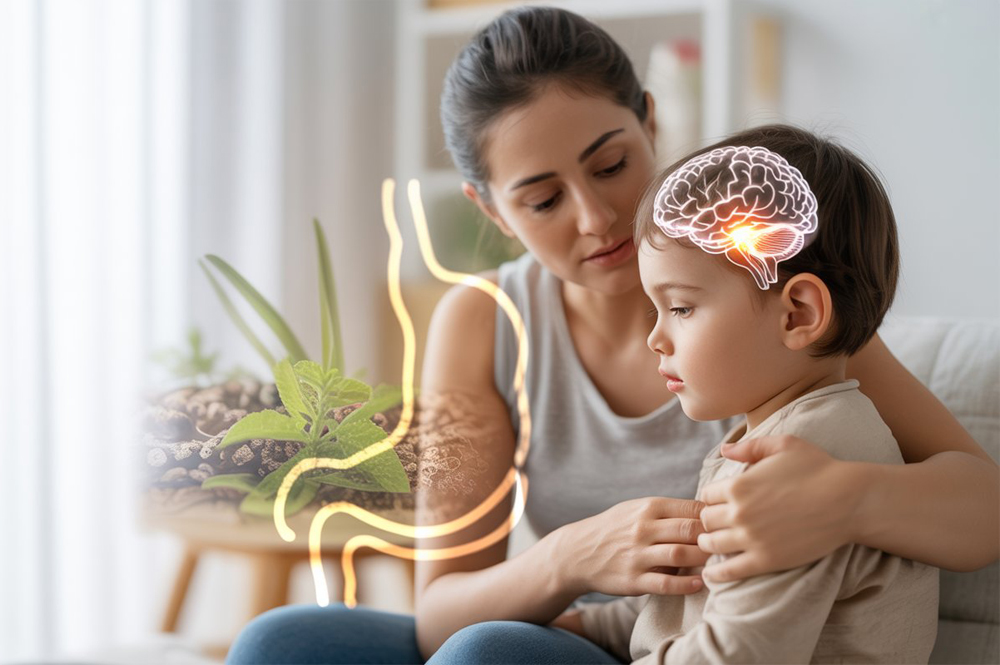
Many children with Autism also have digestive issues: constipation, loose stools, picky eating, food intolerances. Modern research calls this the Gut–Brain Axis — what happens in the gut directly affects brain functioning.
- Undigested food → toxins (ama)
- Toxins → inflammation in the brain
- Inflammation → poor attention, irritability, delayed speech
Neuroplasticity is possible
The brain can rewire itself, especially in children. But this rewiring happens much faster when the child’s internal system is strong. That’s where Ayurveda steps in.
How Ayurveda Views Autism
Ayurveda, India’s 5000-year-old system of medicine, looks at Autism differently from modern medicine.
- Dhi (Learning Power): The ability to absorb and process new knowledge.
- Dhriti (Retention Power): The ability to hold and stabilize knowledge.
- Smriti (Recall Power): The ability to remember and use knowledge when required.
In Autism, this Dhi–Dhriti–Smriti cycle is disrupted. The brain cannot fully learn, retain, or recall. Ayurveda’s goal is to restore this balance.
Ayurveda also recognizes the gut–brain axis long before modern science did. Through herbs, diet, oils, and therapies, Ayurveda works on:
- Removing toxins from the gut.
- Improving digestion and absorption.
- Nourishing brain cells with natural herbs.
- Supporting parents with stress-relief remedies.
This combined approach strengthens the foundation on which therapies can finally start working effectively.
Why a Structured System is the Game Changer
The biggest mistake parents make is following a hit-and-try approach: trying random therapies, diets, or medicines without a structured plan.
- Some weeks it’s only therapy.
- Then a new supplement.
- Then a diet change.
- Then a new doctor.
This scattered approach wastes the child’s golden years of neurodevelopment. Instead, what works is a systematic, phase-wise approach that integrates:
- Internal healing (Ayurvedic medicines, diet, detox).
- External stimulation (Therapies, activities, special education).
- Parental stress management.
When combined, these bring visible results within a predictable timeframe.
Real Success Stories
At Manovaidya, we’ve seen over 100+ families experience breakthroughs with this system.
- Case 1: 5-year-old boy, Delhi
After 2 years of speech therapy, he could only say a few words. Within 4 months of our Ayurvedic neurodevelopmental program, he began making full sentences and responding emotionally to his parents. - Case 2: 7-year-old girl, Dubai
Parents had spent over 3 years on therapy. After integrating Ayurvedic gut medicines and oils, within 6 months she started showing eye contact, responding to questions, and even playing with cousins for the first time. - Case 3: 4-year-old boy, Mumbai
Extremely hyperactive and aggressive, with poor sleep. After 3 months of structured Ayurvedic intervention, hyperactivity reduced, sleep normalised, and therapies began working twice as effectively.
These are not isolated cases — they are proof that when therapies are supported with internal healing, children can progress much faster.
The 180-Day Breakthrough Model
Parents often ask: “How soon can I see results?”
Our structured Neurodevelopmental Care Journey is designed in 180-day phases (6 months).
- First 30–60 days: Better sleep, reduced hyperactivity, improved digestion.
- Next 60–90 days: Speech starts improving, attention span increases, tantrums reduce.
- Next 90–180 days: Social interaction improves, therapies start showing faster progress, learning becomes easier.
This phase-by-phase approach ensures that parents don’t feel stuck in uncertainty. Instead, they can track visible changes and feel hopeful again.
Final Thoughts
So, is Autism really treatable? The answer depends on how you define treatment. If by treatment you mean a magic pill that “cures” Autism overnight, then no — such a pill does not exist.
But if you define treatment as:
- Addressing the root causes (gut, brain, stress).
- Supporting neurodevelopment with natural medicine.
- Strengthening therapies with a systematic approach.
- Bringing visible improvements in speech, behaviour, focus, and emotions.
Then yes — Autism is treatable in a structured way. Parents don’t need to live with hopelessness. The earlier you start, the faster the results.
Take the First Step Today
Book a personalized consultation with our experts at Manovaidya. Together, we’ll design a custom 180-day Neurodevelopmental Plan that combines internal healing, therapies, and parental guidance — helping your child make real, visible progress in speech, behaviour, focus, and social interaction.